


Class of
2025
Humanities & Cultural
Gilbert "Gib" Young

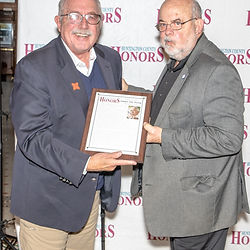
Theodore Roosevelt stopped briefly in Huntington during the presidential campaign of 1900, as Republican William McKinley’s running-mate. The man who would succeed McKinley in the White House just one year after that visit never imagined that, more than a century later, Huntington would be the home of a man who would achieve national renown as … Theodore Roosevelt.
Gilbert Young — known to most as “Gib” — has spent the last 25 years as a luminary in the world of historical interpretation. From a lifelong interest in American history and a striking physical resemblance to Roosevelt — who was a Spanish-American War hero, New York governor, Undersecretary of the Navy, and two-term President — Young undertook a mission to inform and entertain Americans across the country.
“All my life, at different times, people have said, ‘Anybody ever tell you look like Theodore Roosevelt?’ ,” Young said in an interview several years ago. One day a teacher friend asked Young to appear as Roosevelt in front a grade-school class. Young enjoyed the assignment so much he decided the examine Roosevelt’s life in depth, and soon found himself assembling a turn-of-the-20th-century wardrobe and studying film and recordings of Roosevelt — who died in 1919 at age 60 — to capture the distinctive voice and mannerisms of the statesman who was known as “T.R.” to his many friends and admirers.
“I love American history and when I’m doing a presentation, I’m trying to be as true to his character as I’ve found it to be in research I’ve done,” Young has said. “I hope to paint a true picture of what Roosevelt was as a man — in and out of politics. I hope to convey his sense of energy and enthusiasm and his joy of living an active life.”
A native of Lafayette who graduated from Jefferson High School there, Young attended Purdue University and earned a degree in history at Bethel University. He served aboard destroyers as a Navy signalman and moved to Huntington with his wife, Sandy, after his military discharge. The Youngs have three children and three grandsons.
Young’s fascination with America’s past extends beyond Roosevelt’s day. He has an abiding interest in the Civil War, and is a founder of the local chapter of the Sons of Union Veterans of the Civil War, a patriotic organization for which he also has served as Indiana Department Commander. For many years, he was a mainstay of the Champion Hill Toppers Vintage Base Ball Club, which competed in antique uniforms across the Midwest under the game’s 1862 rules. He is a life member of the Huntington County Historical Society, the Mount Rushmore Society, the Devils Tower Natural History Association, and also a member of Huntington American Legion Post 7, the Fort Wayne Civil War Roundtable, and of the Theodore Roosevelt Association.
Young is now retired after 38 years as an agent for State Farm Insurance in Huntington. During that time, he also took his portrayal of Roosevelt to the national stage. Fritz Klein, considered American’s top Abraham Lincoln re-enactor, had caught one of Young’s performances and told him it was the best T.R. he’d ever seen. Before long, the two were working together, entertaining audiences from coast to coast. Their itinerary included annual performances at Mount Rushmore, South Dakota, where they were joined by George Washington and Thomas Jefferson interpreters. Young recalls having a touch of stage fright in his early days as Roosevelt, but overcame that through a determination to give it his best, no matter the size of the crowd. His most recent performances portray Roosevelt as he appeared in his later years, after he left the presidency in 1909.
In the course of bringing a giant of American history to life for audiences in venues as disparate as schoolrooms, cemetery walks, the Smithsonian Institution, and the White House, Young developed a deep admiration for the man who championed progressive political values and conservation of America’s abundant natural beauty — often at considerable political cost.
“He was no demagogue, no politician telling people what he felt what the people wanted to hear,” Young has opined of Roosevelt. “He had an honesty and believed in the righteousness of his cause. I truly believe he was one of those rare individuals who meant what he said and said what he meant, and he had the ability to follow through on the things he believed in and fought for. Not everybody loved him — but it was very hard not to.”
Theodore Roosevelt’s face appears on Mount Rushmore, one of this nation’s most recognizable memorials to presidential greatness. Should anyone ever carve a Mount Rushmore depicting the finest among the small but dedicated legion of historical interpreters, it will likely include the face of a man who has enthralled — and inspired — many thousands of Americans of all ages.